
The just completed New South Wales Women’s Premier Cricket Statistical Review for your perusal.
Category Archives: Uncategorized
Ben Rohrer – by the numbers


Ben Rohrer by the numbers:
- 55 First-Class Matches (2006/07-2015/16), 54 for New South Wales, 1 for CA Chairman’s XI
- 2927 runs at 36.14, 5 centuries (163, 109, 115no, 114, 109no), 17 half centuries
- Highest Score of 163 v Tasmania at Bellerive Oval in 2006/07 on debut in the 2nd Innings of the match
- 10 ducks
- 29 catches
- 5 wickets with best bowling of 4-13 v Victoria at Melbourne Cricket Ground in 2011/12.
- Batsmen dismissed by Ben Rohrer – Andrew McDonald, Cameron Bancroft, Peter Siddle, Will Sheridan and Jade Herrick
- 47 List A matches (2008/09-2016/17) – 43 for New South Wales, 4 for Australia A
- 950 runs at an average of 25.68 and a strike rate of 79.70.
- Highest Score of 80 v Queensland at Manuka Oval in 2012/13
- 5 half centuries
- 2 ducks
- 93 Twenty20 matches (2008/09-2016/17) – New South Wales, Sydney Sixers, Melbourne Renegades, Australia, Delhi Daredevils, Antigua Hawksbills and Sydney Thunder
- 1541 runs at an average of 26.57 and a strike rate of 131.15; 108 fours and 47 sixes
- 3 half centuries
- 4 ducks
- Highest Score of 64 not out for Delhi Daredevils by Rajasthan Royals at Sawai Mansingh Stadium, Jaipur in 2013
- One T20 International for Australia in 2012/13 at Brisbane Cricket Ground scoring 16 off 14 deliveries
- 242 1st Grade matches from 1999/00 to 2016/17 (5th Highest for Fairfield-Liverpool)
- 8790 1st Grade Runs at an average 39.07 (3rd Highest for Fairfield-Liverpool)
- 22 centuries including 2 double centuries
- 37 half centuries
- Highest Score of 205 not out v Randwick Petersham at Coogee Oval; Also the highest score in a 1st Grade limited overs match
- 3548 1st Grade runs at Rosedale Oval at an average of 38.99
- 1000 runs in a season on one occasion (1157 at 57.85) – 2006/07
- Highest Score at positions 3 (175), 4 (205no) and 8 (105) for Fairfield-Liverpool
- 19 ducks
- Dismissed 5 times in the 90s in 1st Grade (91, 92, 92, 90 & 99)
- 7010 runs batting at position 3
- 53 1st Grade wickets at average of 30.72 and a strike rate of 45.89
- Best Bowling of 3-22 v North Sydney at Rosedale Oval, Warwick Farm
- 4 Grand Finals played with 2 victories
Vale Kevin McCarty (1933-2017)
With thanks to Andy Turner
Former ACT player, captain, board member, selector umpire and scorer passed away on the 18th June aged 83.
Kevin made his grade debut for Ainslie in 1947/48 as a 14 year old. In late November 1947, he made 117 not out for the Ainslie Sub District side. He made his ACT debut aged 17 in 1950/51, becoming ACT Player Number 233 when selected for the ACT side which played the New Zealand minor association Upper Hutt on New Years Day 1951. In this match he made an unbeaten 32 and taking 2 for 12. He was not to play for the ACT again until 1959/60 but was a regular fixture of the ACT side during the 1960s. He captained the ACT on five occasions in 1967/68 and 1968/69. Overall in ACT representative cricket, he played 20 matches, scoring 240 runs at an average of 13.33 with a highest score of 56 which was against Newcastle in 1966/67. As a bowler he took 39 wickets at an average of 23.85 with the best bowling of 6-74 against Illawarra in 1964/65. He took one further 5 wicket haul for the ACT in taking 6-85 against Newcastle in 1965/66. He was also selected to play for the Southern New South Wales side which played the touring Indians in 1967/68.
In ACT 1st Grade cricket, he played for Ainslie, Northbourne, Turner and City in a career which lasted from 1950/51 until 1975/76. He played for Ainslie in 1950/51, 1956/57 and from 1958/59 until 1968/69, playing 137 matches for the club, scoring 2684 runs at an average of 19.31 and taking 414 wickets at an average of 15.70. His best with the bat was 111 against Northbourne in 1960/61 while his best with the ball was 8-49 against Northbourne in 1960/61. He played for Northbourne in 1951/52 and 1952/53, playing 14 matches, scoring 242 runs and taking 45 wickets. His best bowling for the club was 6-60 against Turner at Reid Oval.
He played for Turner in 1957/58, playing just four matches, scoring 19 runs and taking 6 wickets. Overall, he played 222 1st Grade matches which is still 10th on the all time list of players. He appeared in Grand Finals on 7 occasions, being on the winning side on 3 occasions. He scored 4114 runs at an average of 18.04, with one century and 17 half centuries. His tally of 566 1st Grade wickets is the fourth highest in ACT 1st Grade history. He had a best bowling of 8-49 and took 5 wickets in an innings on 28 occasions and on a single occasion took ten wickets in a match. He is one of only two players (the other being Lorne Lees) to do the double of scoring more than 4000 runs and taking 400 wickets in ACT 1st Grade cricket history. As well as a long playing career, he also served as President of the Ainslie club from 1963 to 1969 as well as the City District Cricket Club.
Kevin first qualified as an umpire in 1973 and stood as a 1st Grade and Representative umpire from 1978/79 until 1996/97. He umpired 186 matches in 1st Grade which is currently the 5th highest overall and made appearances 27 times in Semi Final and Finals matches. As a representative umpire, he stood in 40 matches. Some of the highlights of his umpiring career include:
- First ACT umpire to stand in the modern era of the Prime Minister’s XI series of matches, when he stood with Tony Crafter in 1986/87 against England.
- Selected as an Umpire for the washed out Prime Minister’s XI in 1988/89 against the West Indies.
- Youth One Day International between Australia and Sri Lanka in 1983/84.
- Two Youth Test Matches in 1985/86 and 1986/87 between Australia and New Zealand and India respectively.
- The Australian Women’s Cricket Council XI match against England in 1984/85.
- The first Women’s ODI in Canberra between Australia and New Zealand in 1988/89 as part of the Women’s World Cup.
He was President of the ACT Umpires Association from 1982 until 1989, at the end of which Life Membership of this Association was added to his trophy cabinet. His memory is revived on an annual basis: the ACT Umpires & Scorers Council’s ‘umpire of the year’ award has been known as the McCarty Medal for 20 years or more.
After his umpiring career was over, Kevin also acted as a representative scorer, mainly between 1999/00 and 2004/05, in an era when scorers were hard to come by in the ACT.
Long before he retired from playing he devoted a great deal of his life to the administration of cricket in the ACT. He was a member of the Grade Cricket Committee during 1968 to 1970 and again in 1978-79; he served intermittently on the ACT Selection Committee between 1966 and 1984; he was ACTCA Treasurer from 1967 until 1970, and served on the Executive Committee from 1967 until 1975. If that wasn’t sufficient service, he topped it up with being ACTCA President for 5 years after his initial election in August 1970. He was made a Life Member of the ACTCA in 1976, and the ‘Manuka Cottage’ included a ‘Kev McCarty Room’ when it became the ACTCA’s administrative HQ in 1992.
Ryan Carters – by the numbers
Teams
Premier Cricket
Western District-University of Canberra – 2006/07-2008/09
Richmond – 2009/10-2012/13
Sydney University – 2013/14-2016/17
Club Cricket
Royston (Central Lancashire League) – 2009
Futures League
Australian Capital Territory – 2008/09
Victoria Under 23s – 2009/10-2012/13
New South Wales Under 23s – 2013/14-2016/17
Twenty20
Victoria – 2009/10-2010/11
Sydney Thunder – 2012/13-2013/14
Sydney Sixers – 2014/15-2016/17
List A
Victoria – 2010/11-2012/13
New South Wales – 2013/14-2016/17
First-Class
Victoria – 2010/11-2012/13
New South Wales – 2013/14-2016/17
Representative
ACT Under 15s – 2005/06
ACT Under 17s – 2006/07, 2007/08
ACT Under 19s – 2008/09
Australia 6s – 2010/11, 2012/13
AIS (Emerging Players Tournament) – 2011
Cricket Australia Invitation XI – 2013/14 (First-Class)
Cricket Australia XI – 2014/15 (Non First-Class)
Cricket Australia XI – 2015/16 (First-Class)
Prime Minister’s XI – 2015/16
Statistics
Premier Cricket
Western District-University of Canberra – 30 matches, 1156 runs at 42.81, HS 151, 2×100, 4×50, 41 catches, 6 stumpings
2006/07 – 1 match, 14 runs at 14.00, HS 14, 2 catches
2007/08 – 15 matches, 583 runs at 48.58, HS 146no, 1×100, 2×50, 27 catches, 2 stumpings
2008/09 – 14 matches, 559 runs at 39.93, HS 151, 1×100, 2×50, 12 catches, 3 stumpings
Richmond – 49 matches, 1992 runs at 44.26, HS 146, 5×100, 10×100, 65 catches, 13 stumpings
2009/10 – 15 matches, 619 runs at 47.61, HS 146, 1×100, 4×50, 18 catches, 1 stumping
2010/11 – 9 matches, 394 runs at 43.77, HS 137, 1×100, 1×50, 6 catches, 3 stumpings
2011/12 – 13 matches, 565 runs at 51.36, HS 102, 2×100, 3×50, 19 catches, 6 stumpings
2012/13 – 12 matches, 414 runs at 34.50, HS 113no, 1×100, 2×50, 22 catches, 3 stumpings
Sydney University – 40 matches, 1334 runs at 43.03, HS 167no, 3×100, 6×50, 67 catches, 3 stumpings
2013/14 – 13 matches, 410 runs at 37.27, HS 88, 2×50, 22 catches, 2 stumpings
2014/15 – 4 matches, 111 runs at 27.75, HS 58, 1×50, 16 catches
2015/16 – 10 matches, 258 runs at 28.67, HS 61, 2×50, 10 catches
2016/17 – 13 matches, 555 runs at 79.29, HS 167no, 3×100, 1×50, 19 catches, 1 stumping
Club Cricket
Royston (Central Lancashire League)
2009 – 17 matches, 469 runs at 29.31, HS 79no, 2×50, 17 catches, 11 stumpings
Youth Championships – 32 matches, 1387 runs at 57.79, HS 146, 3×100, 5×50, 38 catches, 6 stumpings
ACT Under 15s
2005/06 – 5 matches, 212 runs at 70.67, HS 93no, 2×50, 3 catches
ACT Under 17s – 14 matches, 596 runs at 42.57, HS 146, 1×100, 2×50, 15 catches, 1 stumping
2006/07 – 7 matches, 261 runs at 37.29, HS 69, 1×50, 11 catches, 1 stumping
2007/08 – 7 matches, 335 runs at 47.86, HS 146, 1×100, 1×50, 4 catches
ACT Under 19s – 13 matches, 579 runs at 82.71, HS 132no, 2×100, 1×50, 20 catches, 5 stumpings
2007/08 – 6 matches, 278 runs at 92.67, HS 110no, 1×100, 1×50, 11 catches, 4 stumpings
2008/09 – 7 matches, 301 runs at 75.25, HS 132no, 1×100, 9 catches, 1 stumping
Hong Kong International 6s
2010/11 – 3 matches, 35 runs, HS 31no, SR 388.89, 1 catch, 1 wicket, BB 1-33
2012/13 – 4 matches, 25 runs at 12.50, HS 12, SR 178.57, 2 catches.
Futures League – 41 matches, 2083 runs at 41.66, HS 197, 4×100, 9×50, SR 61.41, 232×4, 16×6, 75 catches, 16 stumpings
Australian Capital Territory – 4 matches, 158 runs at 22.57, HS 64, 1×50, SR 35.43, 19×4, 5 catches, 4 stumpings
2008/09 – 4 matches, 158 runs at 22.57, HS 64, 1×50, SR 35.43, 5 catches, 4 stumpings
Victoria Under 23s – 28 matches, 1729 runs at 54.03, HS 197, 4×100, 8×50, SR 70.06, 195×4, 14×6, 53 catches, 11 stumpings
2009/10 – 9 matches, 430 runs at 47.78, HS 109no, 1×100, 2×50, SR 88.11, 11 catches, 5 stumpings
2010/11 – 9 matches, 780 runs at 78.00, HS 197, 2x 100, 4×50, SR 81.42, 21 catches, 3 stumpings
2011/12 – 7 matches, 250 runs at 35.71, HS 88, 2×50, SR 63.94, 8 catches, 1 stumping
2012/13 – 3 matches, 269 runs at 44.83, HS 136, 1×100, SR 42.63, 13 catches, 2 stumpings
New South Wales Under 23s – 9 matches, 196 runs at 17.82, HS 44no, SR 41.00, 18×4, 2×6, 17 catches, 1 stumping
2013/14 – 2 matches, 31 runs at 10.33, HS 15, SR 32.98, 3 catches
2015/16 – 2 matches, 85 runs at 42.50, HS 43, SR 63.91, 2 catches
2016/17 – 5 matches, 80 runs at 13.33, HS 44no, SR 31.87, 12 catches, 1 stumping
Twenty20 – 35 matches, 319 runs at 15.19, HS 35no, SR 99.38, 19×4, 6×6, 29 catches, 2 stumpings
Victoria – 5 matches, 27 runs at 13.50, HS 18, SR 84.38, 3×4, 2 catches
2009/10 – 1 match, did not bat
2010/11 – 4 matches, 27 runs at 13.50, HS 18, SR 84.38, 2 catches
Sydney Thunder – 16 matches, 144 runs at 13.09, HS 33no, SR 91.72, 3×4, 4×6, 12 catches, 2 stumpings
2012/13 – 8 matches, 102 runs at 17.00, HS 33no, SR 93.58, 8 catches, 1 stumping
2013/14 – 8 matches, 42 runs at 8.40, HS 15no, SR 87.50, 4 catches, 1 stumping
Sydney Sixers – 14 matches, 148 runs at 18.50, HS 35no, SR 112.12, 13×4, 2×6, 15 catches
2014/15 – 10 matches, 112 runs at 22.40, HS 35no, SR 124.44, 13 catches
2015/16 – 3 matches, 35 runs at 11.67, HS 27, SR 85.37, 2 catches
2016/17 – 1 match, 1 run, HS 1no
List A – 22 matches, 345 runs at 31.36, HS 65, 1x 50, SR 76.67, 30×3, 3×6, 13 catches, 1 stumping
Victoria – 7 matches, 95 runs at 23.75, HS 44, SR 63.76, 8×4, 1×6, 6 catches, 1 stumping
2010/11 – 2 matches, 13 runs at 13.00, SR 88.67, 1 catch
2011/12 – 4 matches, 82 runs at 27.33, SR 61.19, 5 catches, 1 stumping
2012/13 – 1 match, did not bat
New South Wales – 15 matches, 250 runs at 35.71, HS 65, 1x 50, SR 83.06, 22×4, 2×6, 7 catches
2013/14 – 1 match, 2 runs at 2.00, SR 16.67
2014/15 – 8 matches, 242 runs at 60.50, 1×50, SR 86.43, 6 catches
2015/16 – 3 matches, 6 runs at 6.00, SR 120.00
2016/17 – 3 matches, did not bat
First-Class – 43 matches, 2515 runs at 35.93, HS 209, 5×100, 11×50, SR 41.58, 285×4, 9×6, 66 catches, 1 stumping
Victoria – 11 matches, 360 runs at 18.95, HS 68, 2×50, SR 34.68, 48×6, 1×6, 25 catches
2010/11 – 4 matches, 190 runs at 23.75, HS 68, 2×50, SR 41.30, 1 catch
2011/12 – 5 matches, 134 runs at 16.75, HS 35no, SR 30.04, 23 catches
2012/13 – 2 matches, 36 runs at 12.00, HS 33, SR 27.27, 1 catch
New South Wales – 30 matches, 1812 runs at 37.75, HS 198, 4×100, 8×50, SR 41.53, 201×4, 7×6, 40 catches
2013/14 – 9 matches, 861 runs at 53.81, HS 154, 3×100, 4×50, SR 45.85, 11 catches, 1 stumping
2014/15 – 9 matches, 448 runs at 32.00, HS 198, 1×100, 1×50, SR 39.06, 13 catches
2015/16 – 8 matches, 434 runs at 31.00, HS 77, 3×50, SR 38.34, 16 catches
2016/17 – 4 matches, 69 runs at 17.25, HS 27no, SR 33.50
Cricket Australia Xis – 2 matches, 343 runs at 114.33, HS 209, 1×100, 1×50, SR 53.01, 36×4, 1×6, 1 catch
2013/14 – 1 match, 134 runs at 67.00, HS 94, 1×50, SR 47.35, 1 catch
2015/16 – 1 match, 209 runs at 209.00, HS 209, 1×100, SR 57.42
Centuries
2007/08
146 – ACT Under 17s v Western Australia Under 17s at Russell Lucas Oval, Ringwood
110no – ACT Under 19s v Tasmania Under 19s at Queenborough Oval, Hobart
146 – Western District-UC v Tuggeranong Valley at Manuka Oval (Grand Final)
2008/09
132no – ACT Under 19s v Victoria Under 19s at Newcastle No.1 Sportsground
151 – Western District-UC v Weston Creek at Stirling Oval
2009/10
146 – Richmond v Carlton at Richmond Cricket Ground
109no – Victoria Under 23s v Western Australia Under 23s at Junction Oval, St Kilda
2010/11
137 – Richmond v Prahan at Toorak Park
197 – Victoria Under 23s v New South Wales Under 23s at Junction Oval, St Kilda
164 – Victoria Under 23s v Tasmania Under 23s at Anzac Park, Lindisfarne
2011/12
102 – Richmond v Carlton at Princes Park No.1 Oval, Carlton
102 – Richmond v Dandenong at Junction Oval, St Kilda (Grand Final)
2012/13
113no – Richmond v University at University Oval (Carried Bat)
136 – Victoria Under 23s v Tasmania Under 23s at John Blanck Oval, Bunderim
2013/14
154 – New South Wales v Queensland at Sydney Cricket Ground
100 – New South Wales v Tasmania at Bellerive Oval, Hobart
104 – New South Wales v Western Australia at WACA Ground, Perth
2014/15
198 – New South Wales v Queensland at Sydney Cricket Ground
2015/16
209 – Cricket Australia XI v New Zealanders at Blacktown International Sportspark No.1
(part of record 503 run opening partnership with AJ Finch)
2016/17
113 – Sydney University v Gordon at Chatswood Oval
167 – Sydney University v Sutherland at Glenn McGrath Oval, Caringbah
110no – Sydney University v Bankstown at Bankstown Memorial Oval (Grand Final, Benaud Medal)
Chris Gayle – 1st to 10,000 T20 Runs
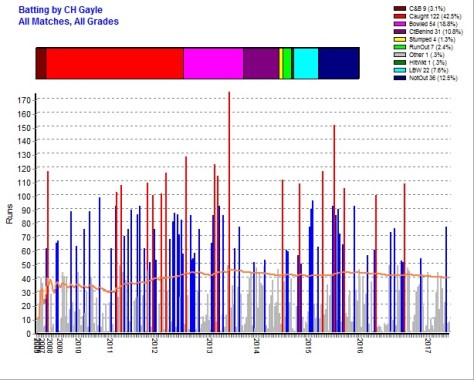
Chris Gayle who has played for 18 Twenty20 sides, became the first player to reach 10,000 Twenty20 runs on April 18, 2017. Here are some of his statistical highlights.
- Gayle made his debut on September 15, 2005 for the PCA Master’s XI against Chilaw Marians Cricket Club in Leicester, not batting and having 0-16 off his bowling in a washed out match.
- Played 292 matches, batting in 287 of them.
- Scored 10,089 runs at an average of 40.36 and a strike rate of 149.11
- Hit 743 sixes and 771 fours.
- Faced 6766 deliveries.
- Made 15 ducks.
- Remained not out in 37 of his innings.
- Passed 1000 runs in a calendar year on six occasions, from 2011 to 2016 inclusive.
- Made 18 centuries and 61 half centuries.
- Played in 98 Indian Premier League matches, scoring 3578 runs at 42.09 and a strike rate of 151.80.
- Highest score of 175 not out against Pune Warriors of just 66 deliveries at Bangalore in 2012/13.
- Passed 1000 career runs in the Indian Premier League, the Caribbean Premier League and T20 Internationals.
- Dismissed most by Dwayne Bravo (on seven occasions).
- Needs just 50 runs to reach 10,000 runs as an opener in Twenty20s.
- Has scored the most runs against Kings XI Punjab with 797 runs at 56.93 and a strike rate of 175.55.
- Has scored the most Twenty20 runs at M.Chinnaswamy Stadium, Bangalore with 1790 runs at 44.75 and a strike rate of 163.47.
- Has been dismissed Caught on 122 occasions, bowled 54 times, caught behind 31 times, leg before wicket 22 times, caught and bowled 9 times, run out 7 times, stumped 4 times, hit wicket once and retired hurt once.
Bill O’Reilly in Sydney 1st Grade Cricket
Bill O’Reilly played first grade cricket in Sydney from 1926/27 until 1948/49. Below is a snapshot of his 1st Grade career in statistics:
- He played in every season from 1926/27 to 1948/49 except for 1928/29 and 1929/30 when he was teaching in country New South Wales.
- He played 165 matches. 39 matches for North Sydney between 1926/27 and 1933/34 and 126 matches for St George between 1934/35 and 1948/49.
- He made 1771 runs in 145 innings at an average of 13.73.
- He made a half century on three occasions.
- His highest score was 73 against Manly in 1931/32 at North Sydney No.1 Oval.
- His other half centuries were 62 against Gordon in 1936/37 at Chatswood Oval and 69 against Western Suburbs in 1947/48 at Hurstville Oval.
- He made 18 ducks.
- He batted at every batting position from opener to number 11. He batted the most at position 9 with 43 innings at that position.
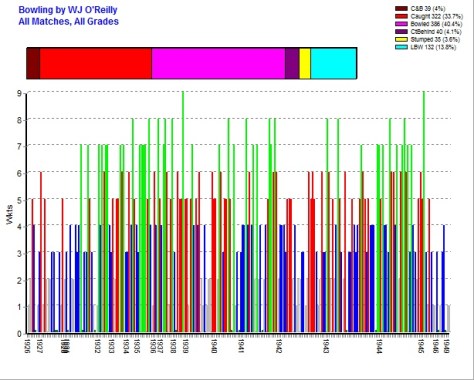
- He took 963 first grade wickets at an average of 9.40
- He took 5 wickets in an innings on 104 occasions, the most against was Manly with 13 occasions, followed by Glebe with 12 and Marrickville with 9.
- He took 10 wickets in a match on 27 occasions, including 15 wickets in a match on one occasion and 14 wickets in a match on 14 occasions.
- His best bowling in an innings was 9-27 against Paddington in 1938/39 at Hurstville Oval. He also took 9-47 against Randwick in 1944/45 at Hurstville Oval.
- He also took 8 wickets in an innings on 13 occasions.
- His breakdown of wickets are 386 bowled, 362 caught or caught behind, 35 stumped, 132 leg before wicket and 39 caught and bowled.
- He took the most wickets against Manly with 112 wickets at 7.17. He took at least 50 wickets against every grade club he played against except for Gordon (42), North Sydney (21) and Sydney University (47).
- He took 338 wickets at Hurstville Oval at an average of 8.87. He also took 107 wickets at North Sydney No.1 Oval at 12.03.
- 39 of his 104 five wickets in an innings came at Hurstville Oval as well as 9 of his 10 wicket hauls.
Serving their Country – ACT Cricket Players in Wartime
The ACT side has had a large number of players who have served the country in the Military Forces. In fact there have been ACT senior representative players who have served the country in all conflicts from the Boer War to the Vietnam War. Having the Royal Military College located in the ACT and their participation in the ACT Grade Competition from it’s inception up until the late 1950s meant that a large number (over 70 at last count) had represented their country as well playing senior cricket for the ACT.
Three players who have represented the ACT have died while on active service.
William Worthy
William John Worthy made his ACT debut at the age of just 18 in 1934/35. Born in Yass in 1916, he played for Hall and Ainslie up until the suspension of the grade competition in 1939/40.
He was a bus driver in Canberra and enlisted in the Army in August 1940. He fought on the Kokoda Track with his battalion and rose to the rank of Corporal. Serving in the 3rd Australian Infantry Battalion in Papua New Guinea, he was killed on active service on 26 November 1942 when the Australian force attacked the Japanese stronghold of Gona in Papua.
He is buried in the Port Moresby (Bomana) War Cemetery. His twin brother, Leslie Charles Worthy had also died on active service in Papua New Guinea in March of 1942.
Edward Jones
Flight Sargent Edward Lloyd Jones died while flying a RAAF Boomerang operating out of the Strathpine airfield in southern Queensland. He crashed into the sea east of Caloundra on 10 November 1943. He was buried at the Lutwyche Cemetery in Brisbane.
Born in 1917, he played for the ACT in 1940/41 in the final match before representative matches were suspended for the rest of the war. He played for the Ainslie club in the grade competition.
He was formerly a member of the Parliamentary Hansard Staff in the Federal Parliament before moving to Hobart and was formerly a journalist with the Canberra Times and Wagga Advertiser.
Robert Nimmo
Robert Harold Nimmo was a member of the first ACT (then Federal Territory) side that played Cooma on Australia Day in 1923. He played for Duntroon in the initial grade competition.
He entered the Royal Military College at Duntroon in 1912 in the second intake. He was awarded the sword of honour as the top student in his intake. He landed on Gallipoli as a troop commander in May 1915 and was evacuated due to illness in August. He served throughout the Palestine campaign in a variety of command appointments. He returned to Duntroon in 1920 was an instructor at the RMC. He also served in various command positions as a Lieutenant Colonel, Colonel and Brigadier in New Guinea. He was promoted to Major General after the War and appointed a CBE in 1950.
Nimmo died in his sleep of a heart attack in 1966 at Rawalpindi, Pakistan while he was acting as the Chief Military Observer to the United Nations Military Observer Group in India and Pakistan. He had served in this role from 1950 until his death. He was buried in the ANZAC section of Mount Gravatt cemetery in Brisbane with full military and UN honours.
Australian Test Cricket Scorers – Part 1
There have been 410 Test Matches played in Australia since 1876/77 until 2016/17. Of these matches there have only been 105 people who have fortunate enough to be an Australian Test Match Scorer.
The scorers in the first Test Match were H Kennon and William Plummer. Not much is known about H Kennon but William Plummer was a scorer for the South Melbourne club and was born in Sussex, England in 1837. These two gentlemen also scored the second Test Match.
The first scorers in a Test Match at the Sydney Cricket Ground were SW Daniels and EC Weller. Daniels went on to score another seven Tests while Weller scored another three.
The first Test Match at the Adelaide Oval was scored by George Gurr and Charles Hobbs. The match was Gurr’s only known Test Match while Hobbs scored one more Test.
Ninion Batchelor, a reporter for Associated Press, became the first Australian to score a Test Match in England when he scored the three Tests on the 1890 Tour.
Joe Taylor from Melbourne and Johann Jackschonn were scoring giants of the 1890s and 1900s. Joe Taylor scored all Test Matches at the MCG from 1884/85 to 1903/04, scoring a number of them on his own when the touring side did not have a scorer with the side.
Johann Jackschon is now known as the father of the linear sheet, having invented his method in the 1890s. Born in Prussia in 1846, Jackschon was a heavily respected scorer, often travelling from Grafton in northern New South Wales to score matches for New South Wales and Australia at the Sydney Cricket Ground. Lord Sheffield, the manager of the 1891/92 English touring side, presented Jackschon with a gold medallion in appreciation of his scoring efforts.
Joe Taylor, who also scored for the Melbourne Cricket Club, scored 11 Test Matches in his scoring career while Jackschon, who scored for the Mosman club scored 13 Test Matches.
Bill Ferguson, known as “Fergie”, has scored the most Test Matches in Australia and overseas for Australian and other Test nations. He became the scorer and baggage master for the Australian Tour of England in 1905 after striking up a friendship with the Australian Test Captain, Monty Noble. He continued scoring for Australian and other touring sides of Australia and other countries just up until his death in 1957. He scored well over 200 Test Matches in his career.
Prime Minister’s XI Match Milestones
1951/52
This was the first Prime Minister’s XI match. It was a one day single innings match with the team batting first being dismissed but also had the option of declaring There were intervals for lunch and tea. The match was also the first match that was washed out during the day.
1965/66
This was the first limited overs match in the history of the Prime Minister’s XI series. It was 35 overs per side with 8 ball overs.
1983/84
The Prime Minister’s XI series was resumed under the tutelage of Bob Hawke, who was also a former cricketer for the ACT. It was the first match which used 6 ball overs and was a limited overs match with a maximum of 50 overs per side. The match also still holds the record of the highest attendance with over 15,000 attending. The match was also the first time a Man of the Match was awarded with David Boon receiving the award.
1985/86
First Prime Minister’s XI match washed out by rain after starting in the limited overs format with only 12.5 overs of play possible for the match before the rain arrived.
1988/89
First Prime Minister’s XI washed out without a ball being bowled. The match was against the West Indies with consistent rain washing out the match.
1993/94
First match which had a reduced number of overs played to completion. Rain during the Prime Minister’s XI innings reduced the match to a 42 over a side match with no change in the target score.
1998/99
First match where a 3rd Umpire was used to adjudicate on decisions.
2005/06
First match decided by run rate with the PM’s XI winning by 6 runs on the Duckworth Lewis Method after a massive storm descended upon Manuka Oval. The match was also the first and only time a replacement player was allowed in the match with Michael Shaw playing the second half of the match as a replacement player.
2008/09
First match using coloured clothing with both the home side and Sri Lanka wearing colour clothing. Previously only white clothing had been used.
2012/13
With the installation of floodlights at Manuka Oval, the first Day/Night match was played in the Prime Minister’s XI series.
2015/16
Pink balls used for the first time in Prime Minister’s XI matches. The match was used a trial for the balls prior to the Day/Night Test Match in Adelaide later in the summer.
2016/17
First match in the series played as a Twenty20 match.
Don Bradman in Sydney 1st Grade Cricket
Don Bradman played 1st Grade cricket for two clubs in the Sydney 1st Grade Competition. He played for St George from 1926/27 to 1932/33 and for North Sydney in 1933/34 after moving to that area after getting married. He originally trialled for Central Cumberland (now Parramatta) but they were unwilling to pay his train fare from Bowral for each match whereas St George was willing to.
He made his 1st Grade debut on November 27, 1926 against Petersham at Petersham making 110 before being run out. He also took 3 for 26.
Some statistical notes on his Sydney 1st Grade Career:
- Overall he made 3221 runs at an average of 89.47, well below his Test and First-Class averages.
- He was never dismissed for a duck in 1st Grade.
- He averaged over a hundred in a season in four successive seasons – 1929/30 (109.80), 1930/31 (215.00), 1931/32 (112.14) and 1932/33 (170.67).
- He made 14 centuries and 12 half centuries.
- Of his 14 centuries, 2 were double centuries.
- He also made a century on debut for North Sydney, scoring 127 against Western Suburbs at North Sydney Oval in 1933/34.
- His highest score was 246 against Randwick in 1931/32.
- He averaged under 50 against three clubs – North Sydney (28.25), Sydney University (39.67) and Waverley (37.00).
- His best season in terms of runs scored was in 1931/32 where he scored 785 runs in 8 innings, averaging 112.14, including 3 centuries and 2 half centuries.
- He batted at every position from opener to number 7, making a century at each batting position except as an opener.
- He scored over 1000 runs at Hurstville Oval, making 1074 runs at an average of 67.12. Nine of his twelve half centuries came at this ground.
- As a bowler, he took 23 wickets at an average of 33.96.
- His best bowling was 4 for 55 against Manly at Hurstville Oval.

